10 Fun and Engaging Ideas to Teach Science Vocabulary
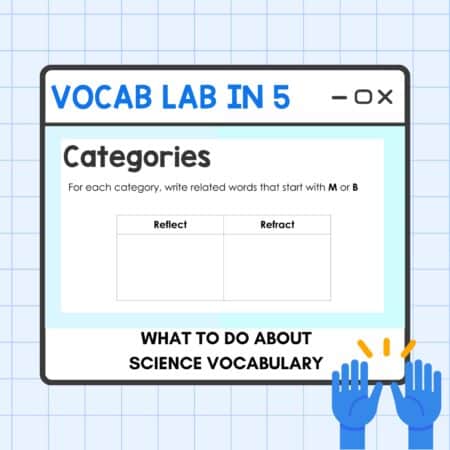
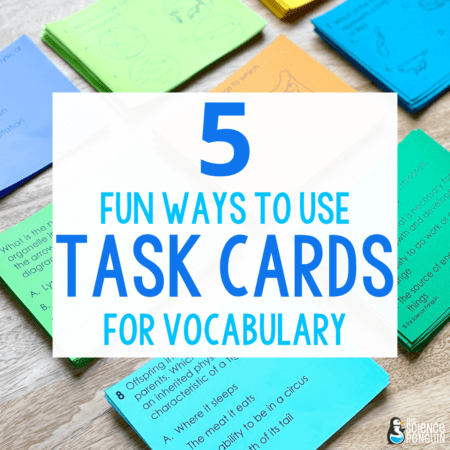
Do the science vocabulary words just seem to not “stick” with some of your students? This is common and can be addressed with a few different activities. Here are 10 ways to bring a little more excitement and creativity to science vocabulary instruction.
1. Science Vocabulary Concept Mapping
Thinking about how terms are connected is much deeper than simply defining the terms. You can do this easily by writing some terms on index cards. In groups, students determine how the terms are connected then explain their reasons aloud or on paper. They might also write on the arrows to show the connections.
2. Concept Building
Concept Building is a powerful strategy to help students become more comfortable with academic vocabulary. Record related nouns, verbs, and adjectives (or descriptive words and phrases) for any term
Concept Building is so effective that I include it in every Small Group Science lesson.
I was thinking about how many of our anchor charts are teacher-made. Sure, we get student input, but what if we had a way to really include students in our anchor chart-making process? Collaborative anchor charts are made by groups of students after completing a task.
To make a collaborative anchor chart for science vocabulary, 4 to 8 students work both together and individually under the teacher’s guidance to complete a task, talk about it, and write about it.
Draw vocabulary squares in notebooks or use printable notebook templates to record the definitions, illustrations, examples, and non-examples for important science terms.
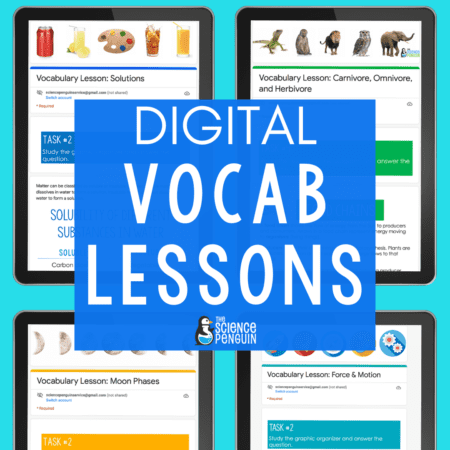
9. Digital Vocab Lessons
Hello there, Google Forms, my friend! These lessons are designed to TEACH students science vocabulary.
For a few key terms, students work their way through videos, graphic organizers, and text to learn the terms. Along the way, they answer 10 questions as they build their understanding.
These auto-grade so all you need to do is check the results to see which students may need more assistance.
Explicitly teaching 3rd, 4th, and 5th grade science content vocabulary just got simpler! Instead of looking for examples, images, and definitions on your own, the work is done for you! Use for word walls!