Consolidation Time During Closure for Science Lessons that Stick

Last week, I read an article about gentoo penguins in a magazine.

    🐧 High-interest topic, check.

    🐧 Appropriate background knowledge, check.

    🐧 Quality presentation of information, check.

Afterward, I put the magazine down, mentioned to my husband that gentoo penguins are handling climate change better than other species because they are highly adaptable to their environment, and moved on with my day.

What is the one thing I can recall about the article seven days later, other than “penguins are a vibe”?

The thing I told my husband.

I opened the magazine and scanned it again just now. OH YEAH! 

Originally, I had noted that I really wanted to remember that they can swim 22 mph, but I completely forgot. 

I had noted the locations of gentoo penguins on a map, but I totally forgot.

And I thought the photo of muddy chicks was pretty cute, but I… you guessed it… totally forgot about it.

Without consolidation time, it’s easy to let even the most interesting information slip away without committing it to long-term memory. 

That one piece of information I remembered? It’s what I had picked out as notable and told my husband. 

Let’s say, instead of moving on with my day, I had jotted down 3 important things I wanted to remember, sketched a muddy penguin, or drew a zooming cartoon gentoo in the water labeled 22mph.

Would I have been more likely to remember it?

What if I revisited my notes and drawings again 3 days later? And again one week later?

The short answer is yes. I would be much more likely to remember those things I initially thought were important (or cute). 

If you’re a teacher, we should probably get into the long answer, which is all about planning for the consolidation phase so students can commit new information to long-term memory.
The end of a lesson can easily sneak up on you. The bell rings or time runs out, and it’s time for the next class or subject. It can be tempting to just move on to the next thing or say goodbye as classes change! 

We know that time is the most valuable resource in any classroom, but saving 5-7 minutes at the end of a lesson for closure and consolidation can leave both you and your students with a satisfying sense of both understanding and preparation for the next day. 

First, let’s get into why this is important!

This idea isn’t just a fad. Effective lesson closure is supported by modern research.

This synthesis of meta-analyses about learning strategies reminds us that there is a difference between acquiring knowledge and consolidating it. When the teacher is presenting information or students are interacting with new concepts during various activities, they are acquiring knowledge that can be held in short-term memory. Consolidation comes afterward, when learners actively process that information. Strategies such as summarizing and connecting new information to what students have already learned can help them consolidate the material, increasing the likelihood that it will be retained in long-term memory.

Lesson closure is often neglected in classroom lessons, according to this article. One quote particularly stands out: “By effectively summarizing the day’s learning, teachers enable learners to articulate what they’ve learned, why it matters, and how they demonstrated their understanding, thus reinforcing the lesson’s objectives and enhancing retention.” After all, isn’t retention a major goal of teaching? 

Here are some tried-and-true practical ideas to help your students consolidate their learning. Dedicate 5-7 minutes at the end of each science lesson to try these out!

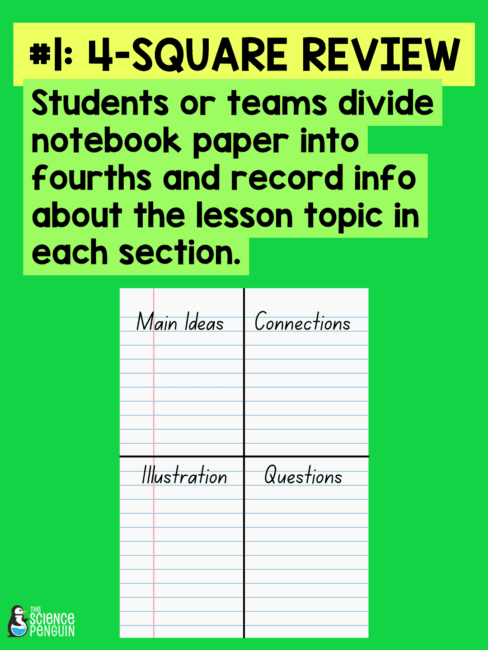
1. 4-Square Review

This can be done in teams, partners, or individually. Have students divide a sheet of notebook paper into fourths. Each section is used for a different purpose:
– Main Ideas: Write the main idea(s) learned today.
– Connections: Write how this connects to the overall unit that the class is studying.
– Illustration: Create a quick doodle to sum up the main idea(s) from today’s lesson.
– Questions: Write any lingering questions from today’s lesson.

It’s important to allow only a couple of minutes to complete this (it doesn’t need to be a masterpiece!) so that volunteers can share their 4-square responses on a document camera during a summarizing discussion.

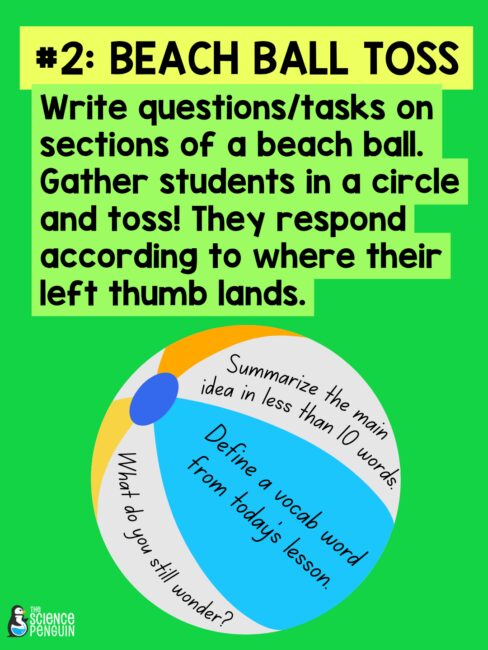
2. Beach Ball Toss

On a beach ball, use a permanent marker to write a question/task in each of the 6 main sections. Students gather in a big circle and toss the ball around. When a student catches it, the section their left thumb touches is the question or task they respond to. Things that you might write could include:
– Summarize today’s main idea in fewer than 10 words.
– Define one vocabulary word from this lesson.
– What do you still wonder about this topic?
– How does this connect to our current unit?
– What’s the most interesting thing you learned in this lesson?
– How does today’s topic relate to your life?

By responding to these questions as part of a group closure, students have a chance to reflect in different ways while having a little fun!

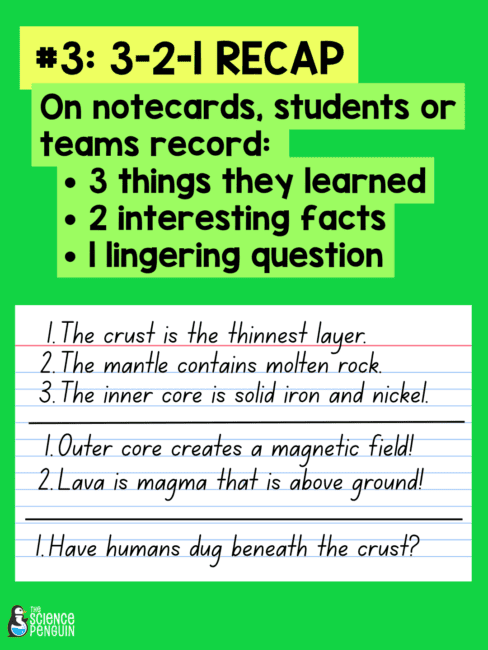
3. 3-2-1 Recap

Pass out notecards for this closure. It can be completed individually, with partners, or in teams. Students record the following:
– 3 things learned in the lesson
– 2 interesting facts that stuck with them
– 1 lingering question

Allow volunteers to share out responses. Other students can raise their hands to indicate if the same thing was on their card, too.

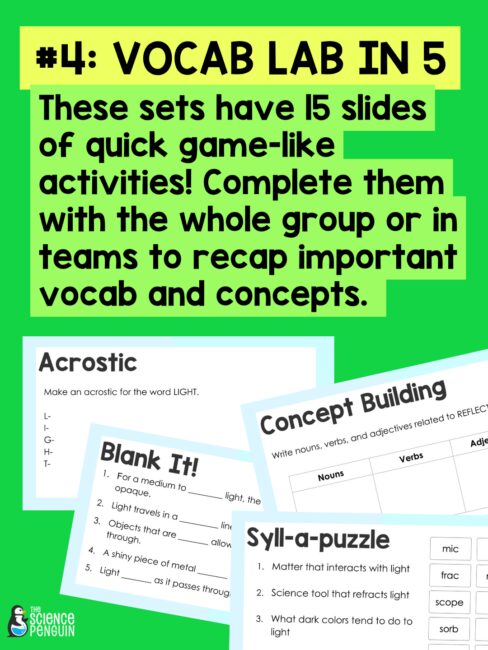
4. Vocab Lab in 5

This Science Penguin resource is designed to explore vocabulary in fun yet effective ways using Google Slides. Each set has 15 slides with quick game-like activities. Crossword puzzles, charades, acrostics, syll-a-puzzles, and other fun options can be projected to complete 1 or 2 a day.

One slideshow can last for many days’ worth of lesson closures. Make sure to discuss the vocabulary with students as you engage with each activity!

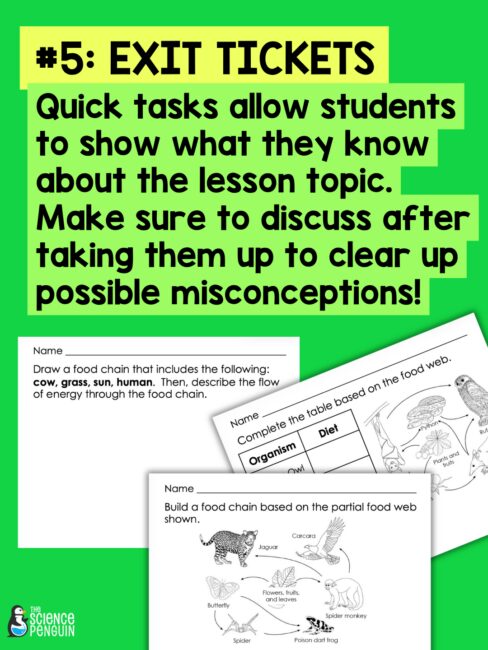
5. Exit Tickets

Short tasks designed to recap the day’s information can help you gauge where students stand. Science Penguin offers sets for Nature of Science, Physical Science, Space Science, Earth Science, and Life Science, covering 140 topics!

When you have students complete an exit ticket, make sure to go over it after taking them up. This provides an opportunity to clear up misconceptions and recap the main ideas from the lesson. You can use their responses to inform instruction for the next day, too.

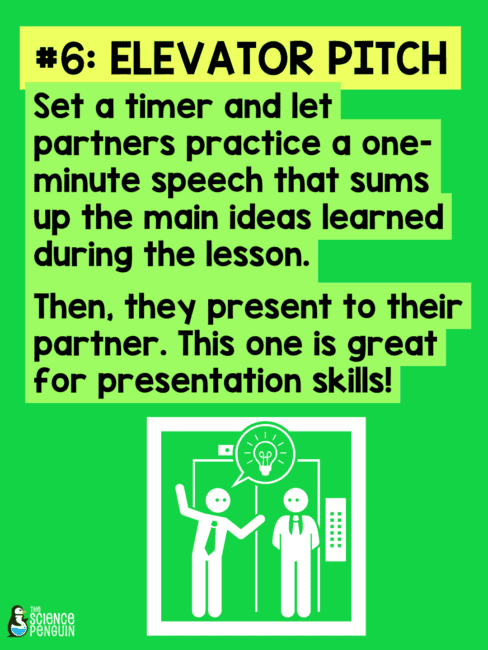
6. Elevator Pitch

Have students work in partners for this one. Set a timer for 2 minutes and have each student think of a 1-minute “elevator pitch” to explain the lesson’s main takeaways to their partner.

Allow the use of resources such as notebooks and other materials used during the lesson. When the timer goes off, they take turns presenting to their partner. If time allows, let a volunteer share. This option is great for working on verbal presentation skills!

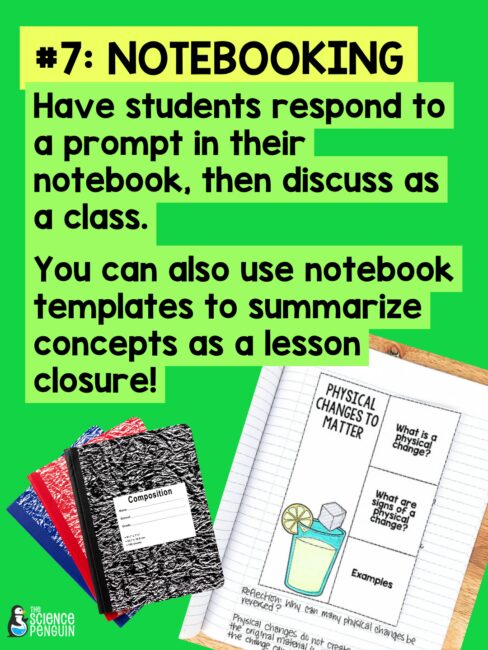
7. Notebooking

Science notebooks are a tool that can be used during lesson closure, too! You can have students reflect on learning by responding to a prompt in writing. Many notebook templates can also be geared toward lesson closure!

Discussions afterward can help uncover misconceptions or help others consolidate learning further.

with any lesson closure, the whole point is to consolidate learning. This won’t happen if you simply collect assignments and move on or release students to their next class.

A quick discussion or summary while incorporating any of our ideas above is important. You want to end the lesson with students having the correct information rather than holding on to possible misconceptions! 


By making effective closure part of your daily routine, students will come to expect it. With practice over time, the goal is for students to be able to reflect upon and summarize new material with ease!

-Ari Mosquera and Holly Hall

Share it:
Email
Facebook
Pinterest
Twitter

You might also like...

Top